When AI Is the Amplifier: Rethinking How We Lead Change and Adoption
By Lee Ackerman
Somewhere in your organization right now, one employee is running a 40-turn AI session against a 100,000-token context, on a top-tier model, to do a task a mid-tier model would have finished for a tenth of the price.
Last year, that didn’t matter as much; the license was a flat fee. The waste was invisible, capped, and already paid for.
This year, it’s showing up on the bill.
That single change, from paying for access to paying for consumption, is the most important shift happening in enterprise AI economics, and most organizations are walking into it backwards. They’re bracing for a pricing problem.
What they actually have is a governance problem that per-seat pricing used to hide.
For two decades, enterprise software was priced per seat. It was predictable, easy to procure, and easy to reason about. Value tracked headcount, so price tracked headcount. AI broke that assumption in a single product cycle. Agents consume tokens, API calls, compute minutes, and workflow steps, and one person can now trigger thousands of model inferences before lunch. Charging per seat for an AI-augmented workflow is like a utility billing you by the number of light switches in the building rather than the power you actually draw.
The market is already turning toward consumption or hybrid models.
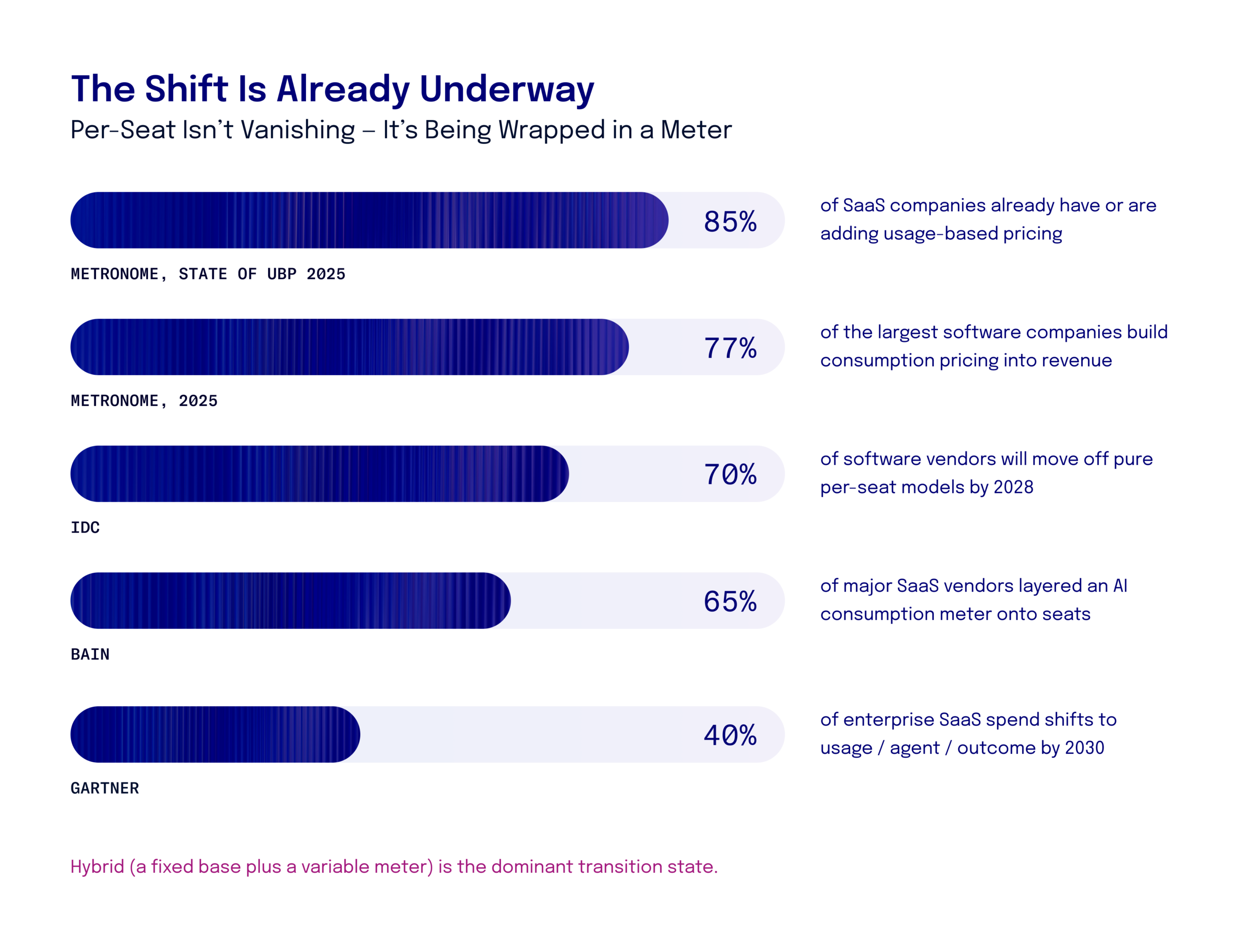
Hybrid (a fixed base plus a variable cost) is the dominant transition state. The details vary by vendor, but the direction is the same. Consumption is here, and it’s growing. The only real question is whether your organization shapes the terms or inherits them.
The pricing debate keeps missing something. Under per-seat pricing, inefficiency was effectively free. The fixed fee absorbed your worst habits, like the untrained user, the wrong model choice, the bloated context window, the shadow tool nobody approved. Waste had a ceiling, and you paid for it whether it happened or not.
Consumption pricing removes the ceiling. Now, every inefficiency carries a price, and those prices compound.
This is why we keep seeing the same headline where an organization abruptly throttles or cuts off AI access because consumption “surprised” them. That surprise isn’t an AI problem. It’s the predictable result of metering an activity nobody was really governing. As Forrester put it bluntly at FinOps X 2025: “Without a dedicated AI cost practice, FinOps teams will get hit by a freight train.”
So, let’s name the dynamic directly: consumption-based pricing reveals waste, and bills you for it. Put another way, it punishes poor governance. But read the flip side carefully, because it’s the opportunity: for the first time, consumption pricing also rewards good governance with a visible, defensible number.
When the bill spikes, the reflex is to cap, throttle, and restrict. Capping spend protects the denominator and destroys the numerator. You can drive your AI bill to zero by turning it off, and produce exactly zero value doing it. You might also stifle innovation and exploration unwittingly.
The right question to ask is “how much value are we getting per dollar of AI spend?” That ratio is value density, and most enterprises can’t answer it because they’re still measuring the wrong thing. The default metric, hours saved, is empirically broken. It might make us feel good, but it doesn’t connect to business value and outcomes or actual business metrics. And it often gets absorbed by other administrative or lower-value activities. You cannot govern spend against a number people are systematically wrong about.
The Value Density Framework (VDF) exists to make AI’s real business impact measurable at the level where work actually happens. Its core metric is a ratio a CFO would recognize:
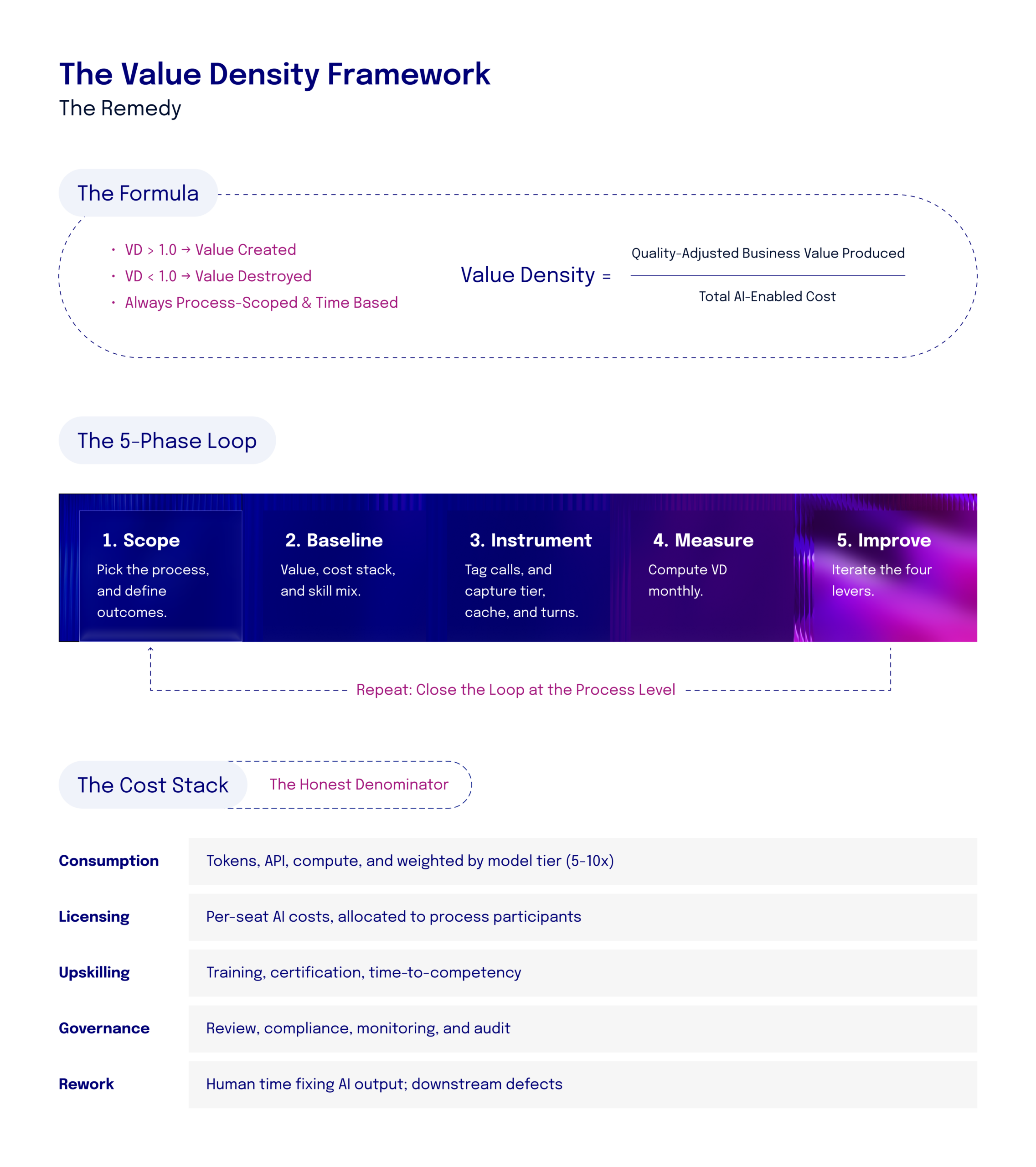
Two things about VDF matter most in a consumption world:
The framework runs as a five-phase loop (Scope → Baseline → Instrument → Measure → Improve), and instrumentation is the binding constraint. BCG found that 60 percent of “future-built” firms rigorously track AI value, versus just 17 percent of stagnating ones. Tracking is the single strongest leading predictor of who gets value from AI and who doesn’t.
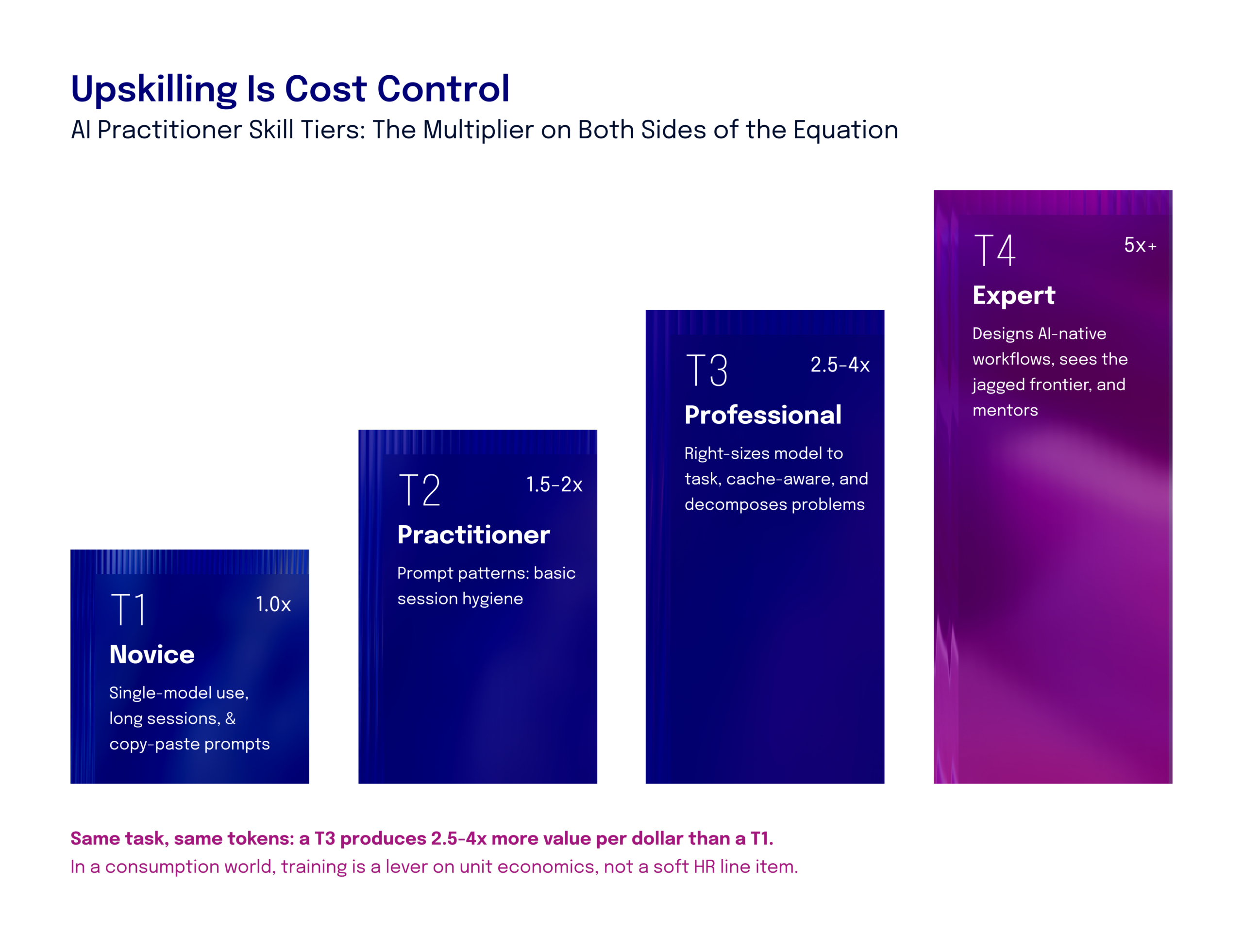
The biggest variable in your consumption bill is the skill of the person at the keyboard, not the vendor’s price. This is the part most cost conversations about AI spend ignore entirely.
VDF treats skill as a first-class input through the AI Practitioner Skill Tier (APST) model. A novice (T1) and an expert (T4) doing the same task do not produce the same bill, or the same value. A T3 professional right-sizes the model, manages context, and decomposes the problem, producing 2.5–4x more value per token than a T1 doing identical work.
The research is overwhelming. Brynjolfsson, Li & Raymond (QJE 2025) found AI productivity gains vary by 2–3x based on skill. Dell’Acqua’s HBS “Jagged Frontier” study found below-median performers gained 43 percent from AI and above-median performers only 17 percent inside the AI’s effective frontier. Outside it, AI users were 19 percentage points more likely to ship incorrect work.
The translation for finance is direct and significant. In a consumption world, training stops being a soft HR line item and becomes a hard lever on unit economics. Moving a workforce from an average skill tier of 1.8 to 2.5 is a measurable value-density lift. Upskilling is cost control.
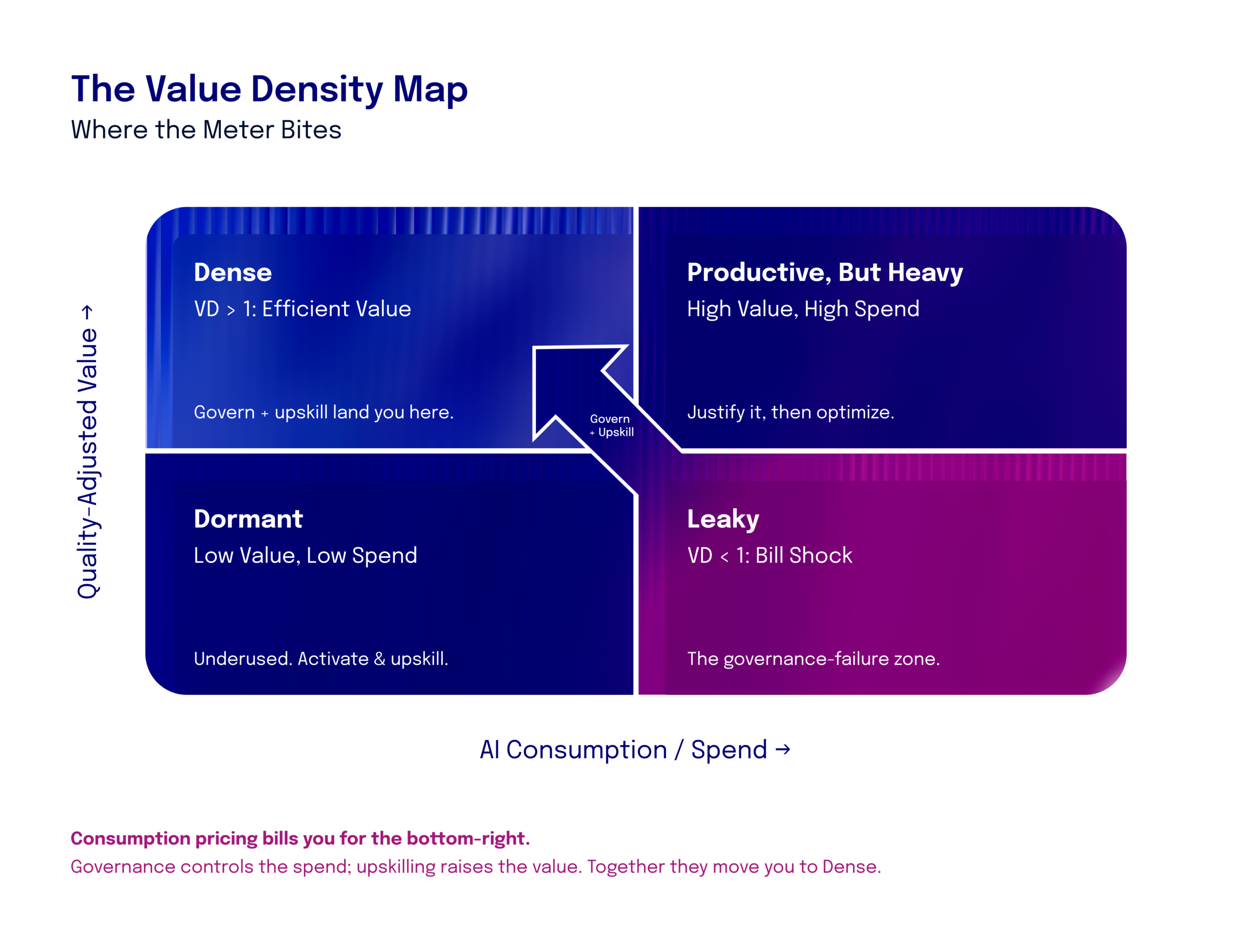
Run it the way the framework is meant to be adopted (Crawl → Walk → Run → Scale), starting with one funded pilot process, rather than an enterprise mandate.
The shift to consumption pricing is an accountability mechanism finally pointed at AI spend. It punishes poor governance, and that is precisely why it’s the best thing to happen to enterprise AI economics. It converts vague unease about “AI cost” into a number you can defend, improve, and stand behind.
In an environment where 95 percent of enterprise GenAI investment produces zero measurable return, that discipline isn’t overhead. It’s the work.
As consumption-based pricing becomes the norm, organizations need more than cost controls. They need a framework for connecting AI spend to business outcomes. One North helps enterprises establish AI governance, measure value density, and build the capabilities needed to scale AI responsibly. Contact our team to learn how the Value Density Framework can help you maximize ROI and turn AI consumption into a competitive advantage.
Photo Credit: Helene Holm | Unsplash
Scott is the Director of AI Innovation at One North, where he leads the development and expansion of AI offerings and capabilities. He specializes in AI innovation, strategy, governance, and adoption—helping clients move at “AI Velocity” by aligning AI initiatives with measurable business outcomes.