When AI Is the Amplifier: Rethinking How We Lead Change and Adoption
By Lee Ackerman
Over the last year, I’ve seen teams fill whiteboards with AI feature ideas — add a chatbot, generate content automatically, create summaries, or build an AI assistant — before they can clearly articulate the user problem they’re solving. While these ideas sound innovative, they often skip the most important question: What user problem are we solving?
The result is predictable. Teams build impressive AI features that generate excitement in demos but struggle to deliver lasting value because they are solutions searching for problems. As several AI product leaders have noted, organizations often start with technology rather than the underlying human need, leading to low adoption and disappointing outcomes. The conversation often starts with “What could AI do?” when it should begin with “Where are users struggling today?”
Akshay Kore advocates for a different approach: start with the job, not the AI. Begin by understanding the work users are trying to accomplish before selecting an AI solution. This mindset draws from the Jobs-to-Be-Done (JTBD) framework, which shifts focus from features and toward the progress people are trying to make. Rather than asking, “How can we use AI?” the question becomes: “What job is the user trying to accomplish, and where are they struggling?”
Once you understand the job, AI opportunities become much easier to identify.
The JTBD framework, popularized by Clayton Christensen, argues that people choose products as a means of making progress toward a goal within a specific context. They “hire” products to help them make progress in a specific situation.
An operations manager does not want another analytics dashboard.
They want to:
The software is merely the means to an end.
The same principle applies to AI. Users rarely wake up wanting an AI assistant. They want to complete a task faster, make a better decision, learn something new, reduce cognitive effort, or eliminate repetitive work.
One mistake organizations make is trying to insert AI everywhere. Experts have repeatedly observed that organizations frequently invest in AI capabilities before understanding where genuine user friction exists. The consequence is poor adoption because the technology does not address a meaningful job. In other words: AI is not the opportunity. User friction is the opportunity.
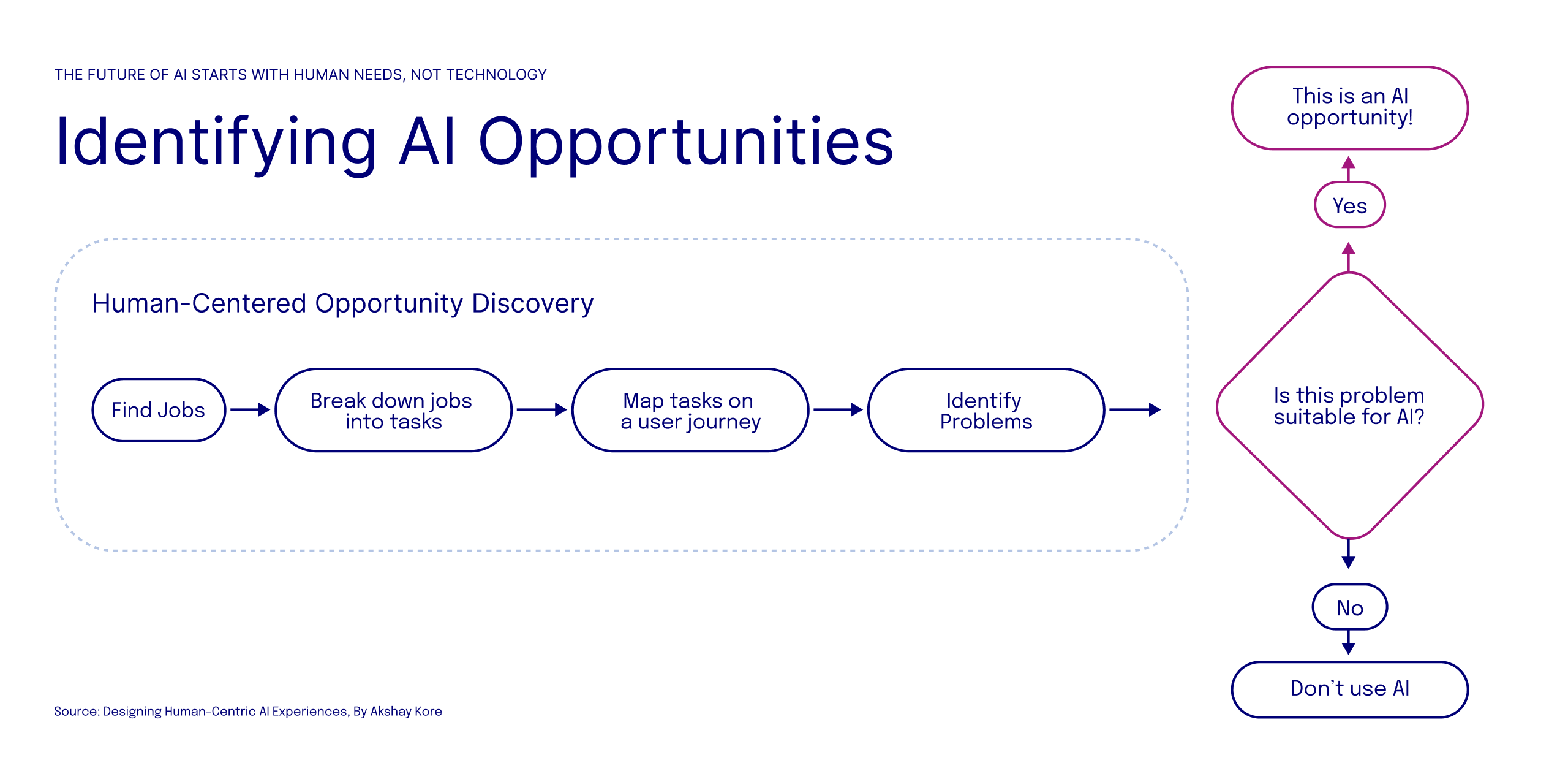
One of the most useful ways to apply Kore’s thinking is to examine existing user workflows and identify points of friction. Start by mapping the user’s journey:
What is the user actually trying to accomplish?
Let’s imagine a flight attendant for this example; here are some jobs they might have:
Where does the process break down?
In a flight attendant’s workflow, they might experience:
These breakdowns often reveal the highest-value opportunities for AI intervention.
Only after understanding the problem should you ask: “What capability could reduce this source of friction?”
Here are some examples of where AI capabilities could augment the flight attendants’ experience:
AI is not the solution for every problem. AI doesn’t fix poorly designed workflows and tools — confusing navigation, tiny touch targets, cluttered screens — this is a user experience problem, not an AI problem.
This sequencing is critical to answer: “Where can AI create meaningful progress for users?” The AI capability is the answer, not the starting point. The JTBD framework and journey mapping can help reveal where AI can create the most value and help identify where AI may currently be causing disruptions or changes to users’ workflows.
Perhaps the most important lesson from the JTBD approach is that organizations should stop prioritizing AI features and start prioritizing outcomes. Rather than chasing technology trends, it encourages teams to focus on the progress people are trying to make.
The next breakthrough AI opportunity in your organization may not come from the latest model announcement. It may come from simply observing a user struggle through a task and asking:
“What job are they trying to get done, and what is standing in their way?”
When you start with that question, AI stops being a technology initiative and instead becomes a tool for helping people make progress. And that’s where the most valuable opportunities are found.
At One North, we help organizations identify where AI can create meaningful value and where better experience design, process improvements, or product changes may be the better solution. If you’re exploring how AI could support your workforce, we’d love to talk.
Photo Credit: Vivid Firefly | Unsplash
As a Lead User Experience Strategist II, Nikole drives a collaborative, human-centered approach to designing digital experiences that improve how people work. She partners with clients to uncover user needs, align business objectives, and deliver solutions that simplify complex processes, creating seamless experiences for both employees and customers.