Key Takeaways from Sitecore Symposium: Platform Unification, AI, and the Future of Experience
By Mike Skutta, Rick Tham
Sitecore Symposium 2026 centered around one idea: the customer journey now starts inside an AI answer, and marketing must be rewired around that.
Sitecore launched MarketingIQ, folded its Scrunch acquisition into the platform, and introduced a new hands-on service model called Sitecore Advantage.
The theme was “Marketing Rewired.” CEO Eric Stine made the point with a personal story: he volunteered to coach his son’s flag football team, asked ChatGPT how to run a practice, and ended up spending more than $1,500 on playbooks, wristbands, cones, and flags from brands he had never heard of. He never intended to buy anything. Awareness, consideration, and intent collapsed into a single conversation, and the brands that showed up in the answer won the business.
That story is the whole conference in miniature. Here is what was announced, what early customers say it is worth, and what it means if you run SitecoreAI.
Everything Sitecore announced rests on the same research from Scrunch Labs: 41 percent of AI sessions never leave the AI platform. No Google search before, no click to the open web after. Scrunch CEO Chris Andrew broke the rest down: 32 percent of consumers start on the web, validate in AI, and return to the web to buy; 16 percent start on the web and finish in AI; 11 percent start in AI and finish on the web.
The second-order effect matters just as much. When an AI platform recommends a brand to someone new, that person is 182 percent more likely to search for the brand on Google, 117 percent more likely to visit its site, and 185 percent more likely to view its products on a retailer page. Showing up in the answer drives everything downstream.
Stine’s view is that the industry is moving from “zero-click search” to “zero-visit action.” The next step after the answer is the customer saying, “book it, order it, register me,” and an agent completing the task without a website visit. Andrew put it more bluntly: the web was built for the Googlebot, and a second web is now emerging for agents.
CMO Michelle Boockoff-Bajdek calls the companies that adapt to this “frontier brands.” Her definition of speed was the distance between seeing a market signal and making a good decision. She warned that machines assemble your brand story from everything that exists about you: the 2022 support article, the distributor page nobody remembers, the Reddit thread, the product description from three launches ago. Her example of the stakes was a customer whose holiday promotion simply did not appear in ChatGPT answers in October, and who lost that revenue.
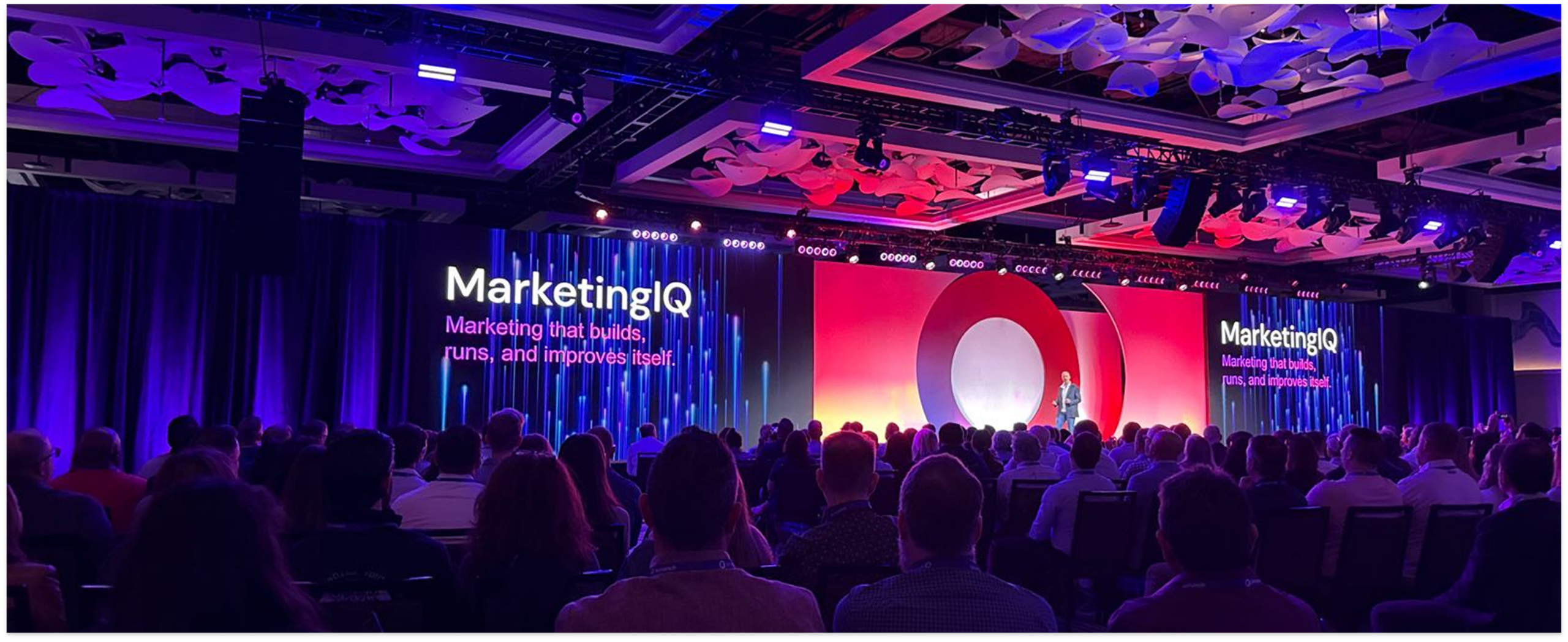
SitecoreAI MarketingIQ is a new module that combines what Sitecore calls contextual intelligence with AI agent orchestration. The pitch is to close a loop: Scrunch spots a demand signal, MarketingIQ puts it in the context of your brand and product truth, agents build the campaign across CMS, DAM, social, and email, the marketer approves, and results feedback in as new signals. Stine’s shorthand was “marketing that builds, runs, and improves itself, at the review and approval of the marketer.”
Chief Product Officer Danny Robinson described it through four pillars:
Sitecore’s example scenario follows a marketer at a running shoe brand who sees nurses asking AI which shoes to wear for a 12-hour shift. One prompt produced a landing page, social ads, and CMS content from approved DAM and PIM assets, all for her review before launch.
The availability news is the headline. MarketingIQ is included at no extra charge for every SitecoreAI customer, CMS or DAM, and goes live the week of November 16. It also comes with any new SitecoreAI agreement regardless of the product you start with, and it connects to non-Sitecore systems such as AEM, Optimizely, and Bynder. For XM and XP customers on 10.2 or later who have signed a SitecoreAI agreement and purchased Scrunch, an XM/XP version is available immediately while the SaaS migration runs.
Sitecore bought Scrunch in mid-2026, and Andrew positions it as an “agent experience platform” with three jobs: observe, optimize, and deliver. His key stat was that 70 to 80 percent of the content AI uses to vet an answer does not come from your own website, so fixing your site is necessary but not sufficient.
Scrunch announced four capabilities, all shipping in November:
On the deliver side, Scrunch is backing “agent pages,” lean versions of content built for machine consumption, and the emerging WebMCP standard, which exposes actions an agent can take on your site. Andrew noted some companies that used to block unknown bots now route them to the agent-page version instead.
Every SitecoreAI customer gets a limited version of Scrunch free for 12 months, inside the SitecoreAI app.
COO Dave Tilbury’s focus is adoption. The following are Sitecore’s numbers from the year since customizable SaaS and Agentic Studio launched:
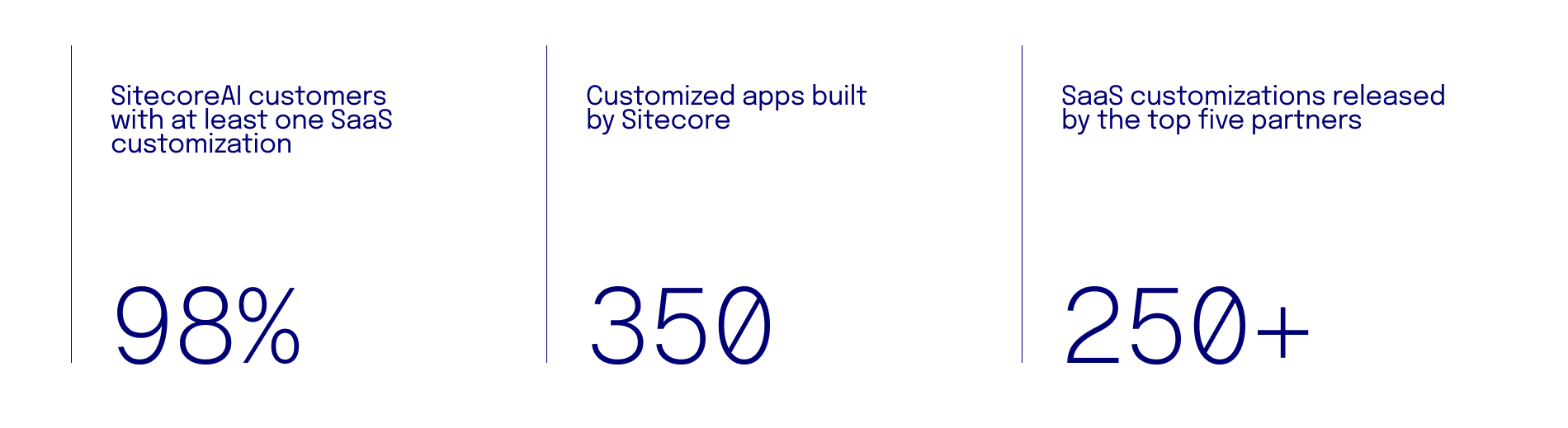
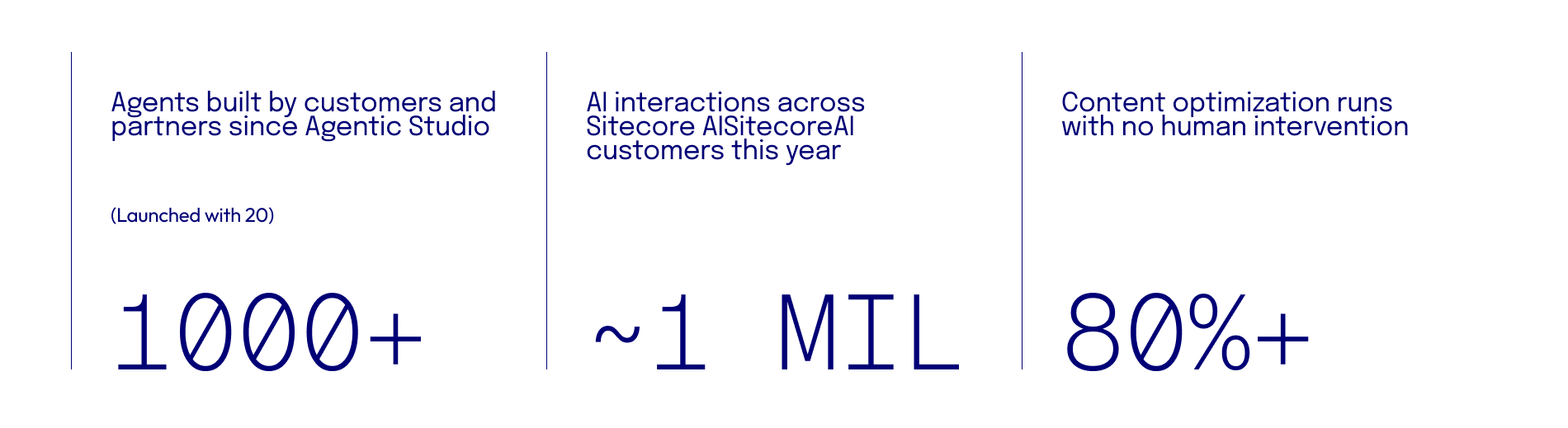
His conclusion was that the final barrier to moving from on-premises to SaaS has been proven away, not just argued away. Sitecore has seen more SaaS migrations in the past year than at any point in its history.
The new announcement was Sitecore Advantage, a proactive forward-deployed engineering service included in Sitecore 360. Sitecore staff who know the product deeply will work directly with customer teams to find unused capability, explain what agents can do, and connect MarketingIQ to existing processes. It is the default model for new SitecoreAI customers, and existing Sitecore 360 customers will be approached account by account. Tilbury was careful to say it works alongside partners and does not replace implementation, integration, or industry expertise.
The practical takeaways depend on where you sit in the Sitecore estate.
If you are on SitecoreAI (CMS or DAM). Two things land in your environment at no charge: MarketingIQ the week of November 16, and a limited Scrunch for 12 months. The first useful exercise is the one Boockoff-Bajdek recommended: pick one opportunity and run it through the full loop. Use Scrunch to see what AI is saying about you, use MarketingIQ to decide what that means for the business, make the change, and measure what happened.
If you are on XM or XP. The message was deliberately inclusive. On 10.2 or later, signing a SitecoreAI agreement and purchasing Scrunch gets you MarketingIQ against your existing on-premises environment immediately. Sitecore is clearly using MarketingIQ as the reason to start the SaaS conversation, and customizable SaaS is now the proven migration path rather than the aspirational one.
If you run a non-Sitecore CMS or DAM. MarketingIQ connects to AEM, Optimizely, Bynder, and others, and comes with any SitecoreAI agreement. Scrunch is also sold standalone.
Content and governance work comes first. Sitecore’s leadership said some version of this repeatedly. MarketingIQ is only as good as the product details, approved claims, customer stories, and sales decks it can reach, and the contradiction agent will surface every place your own pages disagree. Clean, structured, current content is the prerequisite, not a follow-up task.
Decide what agents may do alone. Boockoff-Bajdek’s framing was that marketers set the goals, boundaries, and guardrails — and remain accountable for the result. Tilbury’s data shows agents already running some workflows autonomously more than 80 percent of the time. The design decision is where to draw that line for your brand.
For partners. Sitecore Advantage adds Sitecore’s own forward-deployed engineers to accounts. Tilbury said this is additive to partner work on implementation, integration, and industry solutions. The partner opportunity shifts toward AEO readiness, content structuring for agents, MarketingIQ workflow design, and WebMCP and agent-page delivery.
The song and dance of being the first to appear in front of your customers has a new outfit, but it’s the same dance. Anyone who lived through the SEO craze will recognize the pattern: a shift in how people find things creates a land rush, and a cottage industry springs up promising to get you to the top. It got so saturated that “guaranteed page one rankings” cold emails from random Gmail addresses became a running joke, and many of those same voices are now rebranding as AEO and GEO experts promising to get you into AI’s answers.
The tools on stage at Symposium are real and useful, but they don’t change what makes a brand worth recommending. Your authority, credibility, and trustworthiness aren’t something you declare; they’re determined by what others say about you. Scrunch’s own numbers make the point: 70 to 80 percent of the content AI uses to vet an answer doesn’t come from your website, and Andrew warned that flooding your site with AI-generated pages is something Google now punishes. The shortcuts didn’t work for search engines, and they won’t work for language models, which are built to synthesize the consensus about you.
So the work hasn’t changed: publish accurate, consistent content, earn genuine mentions from sources people trust, keep your own pages from contradicting each other, and give customers a reason to talk about you. Brands that get those fundamentals right will show up in the answer as a byproduct. Brands chasing the latest hack will keep paying for it.
Symposium 2026 was unusually coherent. One argument ran through everything: demand now forms inside AI conversations, that demand is visible earlier than any system marketers have had before, and the winners will be the brands that can see the signal and act on it while the moment still matters. Stine called it demand-driven personalization. Instead of modeling cohorts from past purchases, the customer brings the context in the question they ask.
The open question is the last step. Agents transacting on your behalf, through WebMCP and agent pages, is where Sitecore says this is heading. How enterprises grant that autonomy while keeping compliance and brand safety intact is not solved yet, and Robinson’s Control pillar is the first attempt at an answer rather than the final one.
The most memorable idea came from Boockoff-Bajdek. An agent can find the product, compare the options, and place the order, but it cannot create loyalty or fandom. Her Chipotle example, a three-foot takeout bag tied to a rewards program, was absurd on purpose. The goal is a preference so strong it becomes an instruction to the agent: make sure it comes from Chipotle. Technology handles the preparation. Humans still own the reason someone chooses you.
If you’re ready to explore what this means for your organization, our team of experts can guide you through the process.
Photo Credit: Milad Fakurian | Unsplash
As Lead Architect at One North, Mike helps clients navigate complex technology decisions and turn emerging capabilities into practical, scalable digital experiences. His work spans modern digital experience architecture, Sitecore, and AI, with a focus on evaluating new technologies, solving complex technical challenges, and creating strong foundations for what comes next.
Mike is also a longtime Sitecore expert, former 5-time Sitecore Technology MVP, and an active contributor to One North’s thinking on the future of digital experience, including how AI is reshaping the customer journey and the platforms marketers use to support it.
As a Practice Architect at One North, Marcel Gruber brings a broad technical perspective to building and evolving modern digital experiences. His expertise spans full-stack development, digital experience platforms, SEO, analytics, DevOps, and AI, allowing him to connect technology decisions to the broader needs of marketers, users, and the business.
An active 4-time Sitecore Technology MVP, Marcel is recognized for his expertise and contributions to the Sitecore community. He combines deep technical knowledge with a pragmatic, data-informed approach to solving client challenges.