Stoking the Creative Fire
By Kevin Leahy
When organizations face disruption, the instinct is often to focus on what customers can see: refresh the website, update the messaging, redesign the logo, or launch a new campaign.
While those changes can be helpful, they rarely solve the real problem. Like a sinkhole, brand failures don’t start at the surface. They begin underneath.
In geology, sinkholes form when erosion weakens the foundation below the ground. Everything appears stable until, suddenly, it isn’t. Businesses operate much the same way. Markets shift, customer expectations evolve, competitors emerge, and new technologies reshape industries. Long before customers notice, pressure is building beneath the brand.
That’s why it’s helpful to think of brand as a geological system made up of three interconnected layers: Experience, Validation, and Identity. Beneath every successful customer experience lies a bedrock of market validation and organizational identity, much like the geological structures that support the Earth’s surface. When those layers are aligned, a brand can adapt to change. When they become disconnected, cracks begin to form.
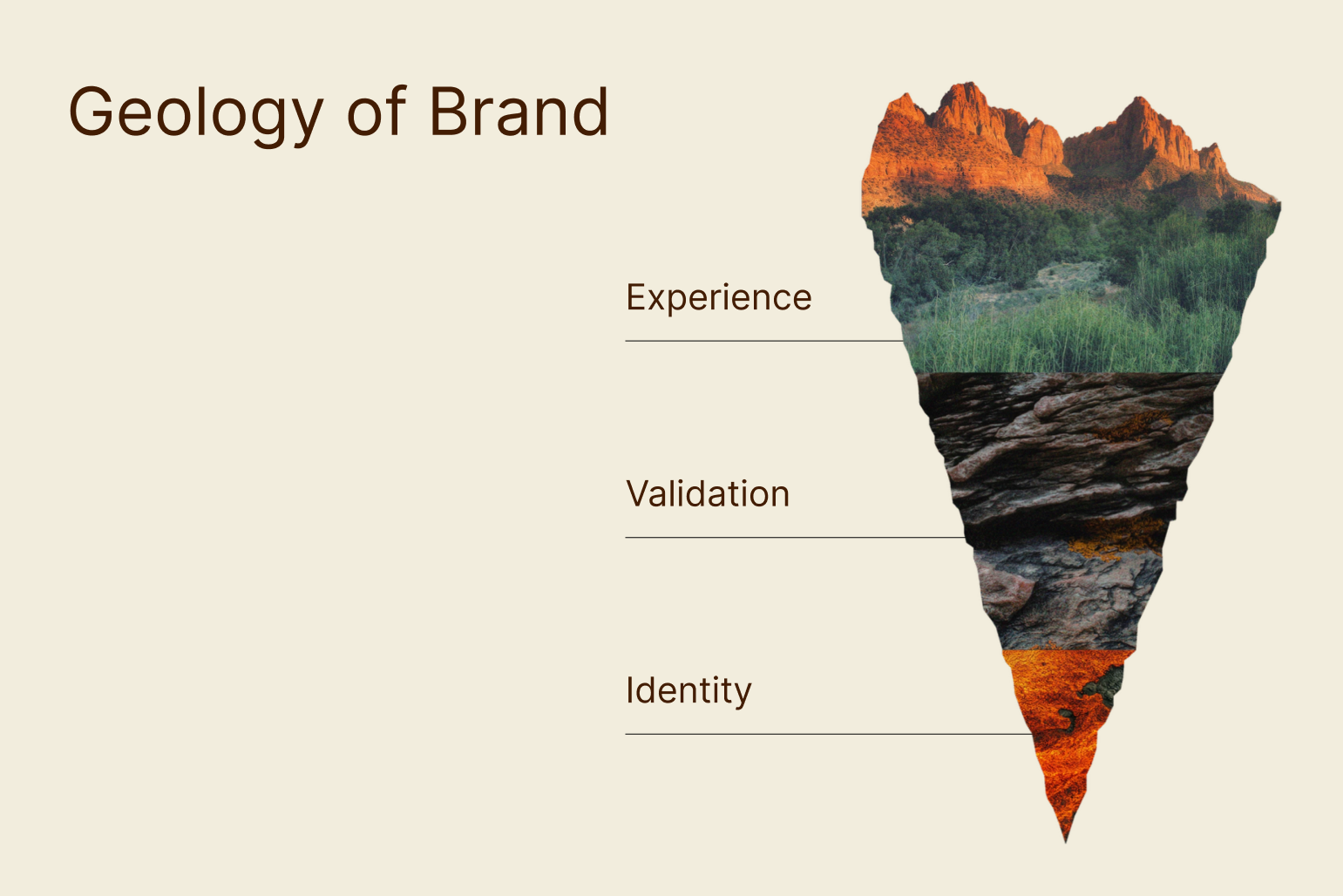
At the surface is Experience: the website, campaigns, messaging, products, and customer interactions that shape how people perceive the brand. Beneath that sits Validation, the layer where organizations test assumptions, monitor market shifts, gather research, and evaluate how customer needs and competitive conditions are changing. At the center is Identity: the mission, values, purpose, and core competencies that define who an organization is and what it stands for.
Together, these layers create a more resilient brand. Identity provides direction, validation helps organizations adapt to changing conditions, and experience brings the brand to life for customers. The strongest brands aren’t the ones with the most polished exterior. They’re the ones with a strong core and a system that can withstand pressure without losing sight of who they are.
Every business relies on assumptions, but few take time to identify them. A useful question to ask is: What assumption does our business quietly lean on, and what happens if it changes?
Peloton offers a powerful example. During the pandemic, its success was built on the belief that home would become the primary place for fitness. When people returned to gyms and in-person workouts, that assumption weakened. The challenge wasn’t simply declining demand; it was redefining what the brand meant when its foundational belief changed.

The sinkhole wasn’t the bike. The sinkhole was the assumption beneath it.
Organizations that understand their underlying assumptions are far better prepared when markets inevitably shift.
Brand identity should do more than guide marketing. It should guide decisions.
When new opportunities arise, leaders should be able to ask whether a product, service, or strategy aligns with who the company is and what it stands for. If every opportunity seems equally attractive, the brand may not be providing enough strategic clarity.
Strong brands make it easier to evaluate trade-offs, determine where to invest, and identify opportunities that may create growth at the cost of long-term credibility.
In this way, brand becomes less about communication and more about alignment.
As market conditions continue to accelerate, particularly in the age of AI, organizations need faster ways to validate decisions before making significant investments.
New research approaches, including synthetic market research, allow teams to test ideas, evaluate demand, refine positioning, and understand audience preferences much faster than traditional methods. The goal isn’t to eliminate risk entirely; it’s to identify weak assumptions before they become expensive mistakes.
In rapidly changing markets, validation creates confidence. It helps organizations move quickly without moving blindly.
The good news is that even when a sinkhole appears, it doesn’t have to destroy a brand.
The National Corvette Museum demonstrated this when a sinkhole swallowed several historic Corvettes in 2014. Instead of hiding the event, the museum embraced it as part of its story. Damaged vehicles became exhibits, and what could have been a crisis became an opportunity to deepen customer loyalty and engagement.

The lesson is that resilience often becomes part of the brand itself. How an organization responds to disruption can be just as important as the disruption itself.
When organizations feel instability, the answer isn’t always a rebrand, a redesigned website, or a new campaign. Those are surface-level responses to what are often much deeper challenges.
Strong brands are built by understanding their core identity, recognizing market pressures early, and validating decisions before they reach the public.
Because in every industry, the ground will eventually shift.
The brands that endure aren’t the ones with the shiniest surface. They’re the ones with the strongest foundation.
The ideas shared here originate from Kathy Binkley’s Assembly 2026 presentation. To hear the complete conversation, watch the session, linked below.
Photo Credit: Roberto Sorin | Unsplash