The Curve We Choose
By Breanne Hamilton
At Figma Config 2026, one trend was impossible to miss: AI is changing who gets to create.
Figma shared data showing designers becoming more involved in development and developers becoming more involved in design. As AI lowers the barriers to creating, building, and experimenting, people are contributing beyond the boundaries of their traditional roles.
Designers and developers now have a seat at the canvas. That raises an interesting possibility: what happens when users gain access to the canvas, too?
For decades, we’ve asked users to describe the future they want. Increasingly, they’ll be able to help create it.
AI is making it easier than ever to turn ideas into something tangible. Concepts that once required specialized tools and expertise can now be visualized in seconds.
For the first time, many users can participate from the same canvas as the teams designing and building the experience.
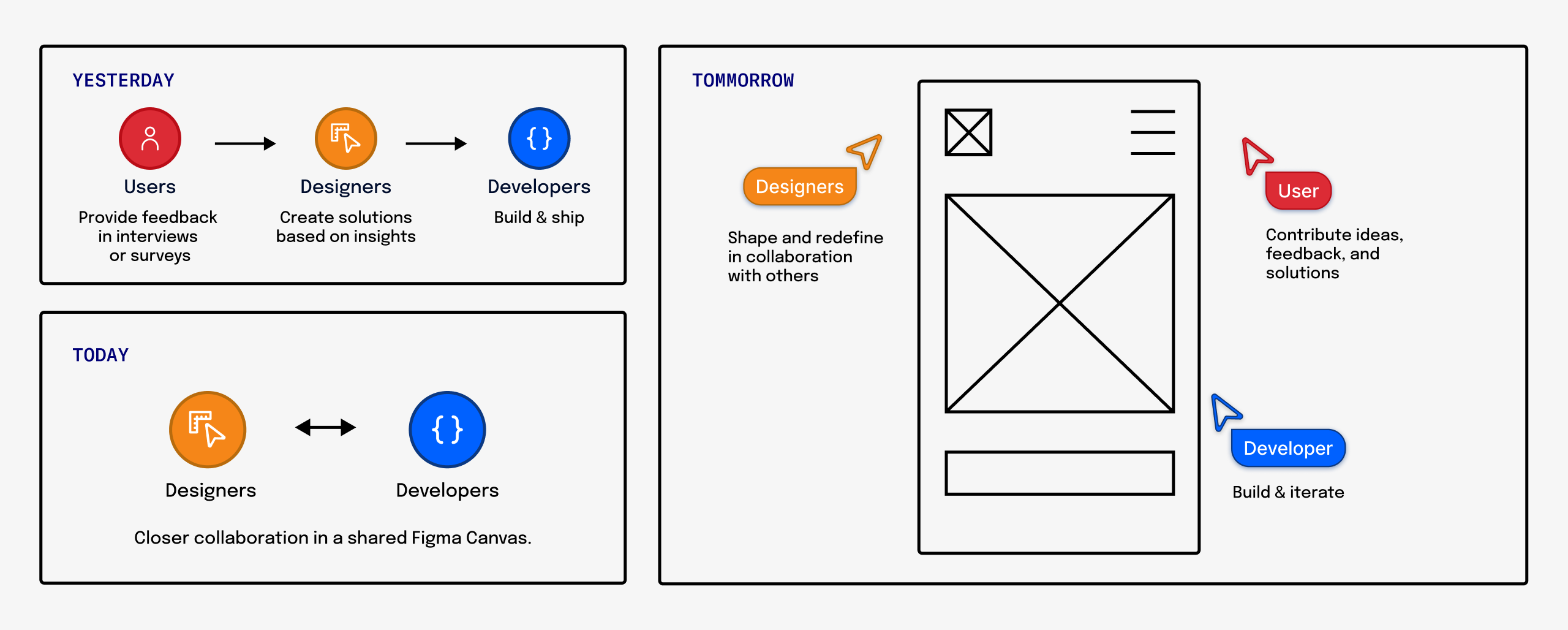
They can sketch ideas, remix workflows, generate concepts, and react to something concrete rather than hypothetical. Not because every user is becoming a designer, but because AI is giving people new ways to express what they know.
And users know something no design system, framework, or AI model ever can: what it’s like to live with the problem every day.
The value isn’t that every user-generated idea will be brilliant. Most won’t be. The value is that rough ideas often reveal needs that polished conversations miss.
A sketch can expose an assumption. A prototype can uncover friction. A generated concept can spark a conversation that might never emerge in an interview or survey.
That’s why I believe this moment represents more than a shift in tooling. It represents a shift in participation.
As creation becomes more accessible, our role as designers becomes less about being the only people who can make ideas visible and more about helping the right ideas emerge. We still bring strategy, systems thinking, accessibility, judgment, and craft. But perhaps our most important contribution is creating the conditions for better collaboration.
AI is already expanding the canvas from design to development. The next opportunity is expanding it to the people we’re designing for.
Because if AI is democratizing creation, users shouldn’t just help us evaluate the future. They should help us create it.
The organizations that stand out won’t be the ones creating the most ideas. They’ll be the ones creating with the people who matter most. Discover how One North helps organizations bring customers, employees, and stakeholders into the process of shaping what’s next.
Photo Credit: Eveling Salazar | Unsplash
As a Senior Manager, UX Strategy, Breanne drives a collaborative and user-centered approach to ensure clients are solving the right problems during the discover, define and design phases of a project. She specializes in the co-creation process and ensures our solutions intersect end-user needs and clients’ business objectives.