The Geology of Brand
By Kathy (Grunditz) Binkley
For years, omnichannel strategy was largely a conversation about channels. How do customers move between digital and physical experiences? How do organizations connect systems, teams, and touchpoints?
Today, the conversation has evolved. As AI enters the customer journey, organizations are increasingly focused on a different question: how do we design experiences around customer intent rather than the channels customers happen to use?
That question became the foundation for a lively discussion at One North’s Toronto Omnichannel Mini Assembly, revealing several important lessons for organizations navigating the next era of customer experience.
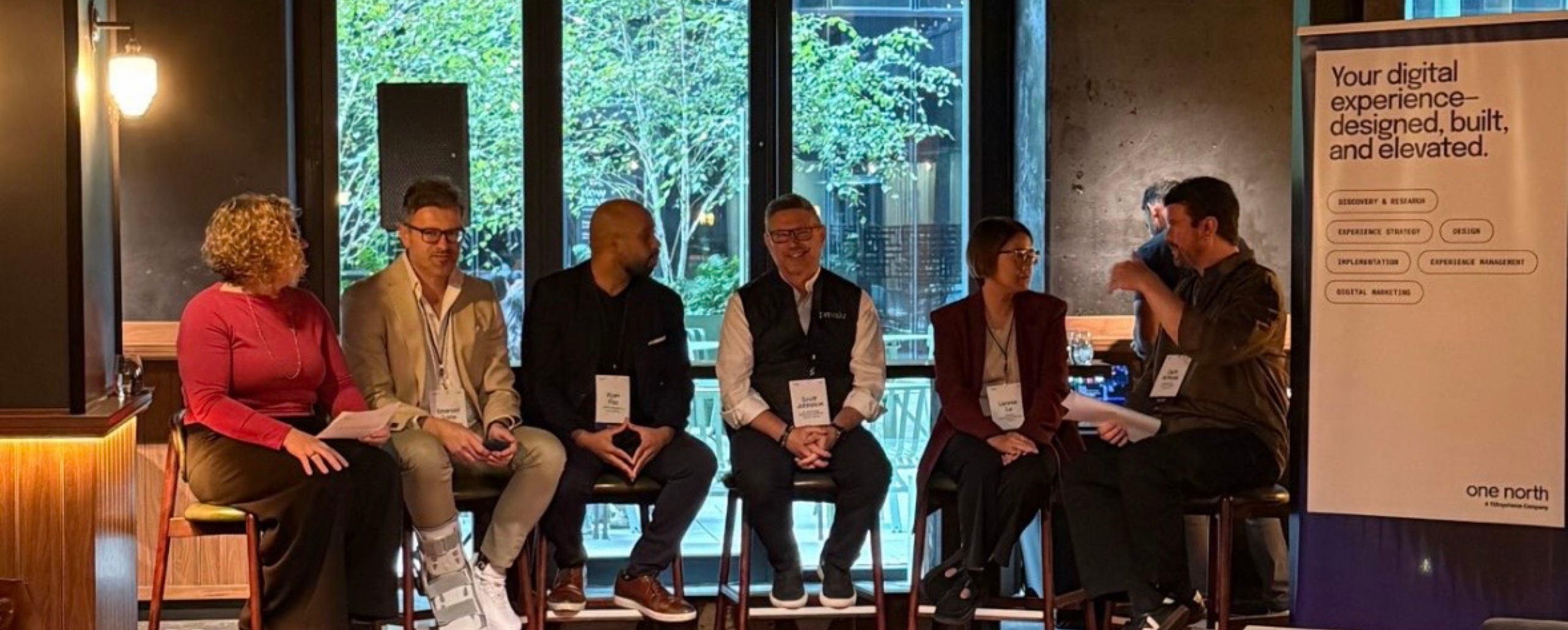
Moderated by Kat Kollett, Advisor, Experience Transformation at Allegis One, the discussion brought together leaders from banking, insurance, retail, and commerce, including Zach Schloss, Senior Director of CX & UX Strategy at One North, Scott Johnston, VP of eCommerce & Customer Experience at Pet Valu, Emanuel Toste, Director of Experience Design at BMO, Ryan Pais, AVP, Guided Omni at Co-operators, and Lennie Lu, Director of Experience and Strategic Planning at Staples Canada.
While each organization faces unique challenges, several common themes emerged throughout the conversation. From AI adoption to customer trust, the discussion revealed that successful omnichannel experiences are less about technology itself and more about understanding what customers are trying to accomplish.
One of the strongest themes of the evening was the idea that customers do not think in channels. They think in goals.
Whether a customer begins in a mobile app, walks into a store, calls a contact center, or engages with an AI-powered tool, they are simply trying to achieve an outcome. The organizations represented on the panel are increasingly shifting their focus away from optimizing individual touchpoints and toward understanding the intent behind customer interactions.
That shift requires organizations to connect experiences that have historically been owned by different teams, supported by different technologies, and measured through different metrics. The challenge is not simply creating more channels. It is ensuring customers can move across channels without friction while maintaining confidence that the organization understands their needs.
As self-service capabilities become more sophisticated, organizations continue to evaluate which interactions should be automated and which require a human touch.
Panelists shared examples ranging from password resets and order tracking to insurance claims and banking support. Across industries, there was broad agreement that automation works best when it eliminates routine tasks, reduces wait times, and helps customers accomplish simple goals more efficiently.
At the same time, moments involving uncertainty, emotion, trust, or major decisions still benefit from human support.
The consensus was clear: the goal is not to replace human interactions. It is to reserve them for the moments where they create the most value.
Organizations that strike this balance effectively can improve efficiency while maintaining the personal connections that customers continue to expect.
Not surprisingly, AI was a major topic throughout the discussion. What was perhaps more notable was the cautious approach many organizations are taking toward customer-facing applications.
While AI capabilities continue to evolve rapidly, panelists repeatedly emphasized the importance of getting experiences right before putting them in front of customers. In industries where trust is essential, a poor AI experience can create reputational risk that far outweighs the potential efficiency gains.
As a result, many organizations are focusing first on controlled experimentation, pilot programs, and internal use cases before expanding customer-facing experiences.
This measured approach reflects a broader reality: customers may be curious about AI, but they are ultimately evaluating organizations based on outcomes, accuracy, and confidence, not the novelty of the technology being used.
While customer-facing AI remains a work in progress, for many organizations, operational AI is already changing how teams work.
Panelists described using AI to summarize research, synthesize customer insights, generate transcripts, streamline workflows, accelerate documentation, automate repetitive tasks, and surface information that would previously have required significant manual effort.
The common thread across these use cases is not replacing expertise. It is removing administrative burden.
By automating lower-value work, teams can spend more time on activities that require judgment, creativity, strategic thinking, and customer understanding. In many cases, that is where organizations are seeing the most immediate return from their AI investments.
Another recurring topic was the impact of AI on the pace of work.
Teams are able to move faster than ever. Processes that once took days may now take hours. Information that required extensive manual research can often be gathered in minutes.
But greater speed comes with new challenges. Expectations rise. Delivery timelines compress. The pressure to produce more can increase just as quickly as productivity gains.
Several participants noted that organizations need to be intentional about where they accelerate and where they slow down. Critical decisions involving customer experience, trust, accessibility, governance, and differentiation still benefit from thoughtful human review.
Technology may reduce friction in many places, but strategic friction remains essential where quality and judgment matter most.
Toward the end of the discussion, participants explored a rapidly emerging question: how customer experiences will evolve as AI agents begin acting on behalf of consumers.
Although few organizations feel fully prepared for this shift today, there was broad agreement that success will depend on the fundamentals they have already been working toward: connected data, cross-functional alignment, clear governance, and unified customer experiences.
The conversation highlighted an important reality. AI tends to amplify existing conditions. Organizations with fragmented systems, disconnected data, or siloed teams may see those challenges become more visible. Organizations with strong foundations will be better positioned to take advantage of emerging technologies and evolving customer expectations.
If there was one takeaway from the evening, it was that the future of omnichannel experience is not simply about adding more technology.
The organizations making the most progress are focusing on customer intent, building trust, creating seamless journeys across channels, and applying AI where it genuinely improves outcomes.
As customer expectations continue to evolve, the challenge is no longer choosing between digital and human experiences. It’s designing systems where both work together seamlessly, delivering the right experience at the right moment for the right reason.
Special thanks to our moderator, Kat Kollett, and panelists Zach Schloss, Scott Johnston, Emanuel Toste, Ryan Pais, and Lennie Lu for sharing their perspectives, experiences, and insights.
The future of customer experience won’t be determined by how many channels an organization offers. It will be shaped by how effectively those channels work together to help customers achieve their goals. One North helps organizations design and deliver connected experiences that balance technology, human interaction, and business needs, creating journeys that build trust and drive results.
Photo Credit: Vitaly K. | Unsplash
As Marketing Manager, Andrianna helps drive the creation and execution of impactful content across platforms, showcasing One North’s expertise and thought leadership. Passionate about crafting compelling narratives, she focuses on strengthening industry leadership and inspiring meaningful client connections.