Beyond the Framework: Building Resilient Front-End Architectures for Adobe Experience Manager
By Hunter Trammell
In the midst of the relentless flow of technical innovations, organizations are racing to keep pace with the promise of value driven by technologies like AI. With the constant advancements in marketing and personalization tools, the adoption of MarTech (Marketing Technology) strategies and platforms have grown substantially over the last few years. Organizations are investing heavily in strategies to scale their marketing capabilities, yet few ask the harder question: what actually makes them work at scale?
These strategies are centered around MarTech platforms that deliver technical solutions without dependency on development timelines. Traditional barriers between marketing and technology are shifting to a collaborative model, one where technology enables the tools and marketers work independently to deliver relevant experiences across channels. While this shift has given organizations a sense of direction, it also creates the illusion that technology alone can close the gap between capability and execution.
The reality is more complicated: even with the most advanced platforms, organizations still face limits in how quickly they can adapt to new technologies. Scott Brinker’s Martec’s Law illustrates how the velocity of technological change increases exponentially while the potential for change and adaptation within an organization slows as scale increases.
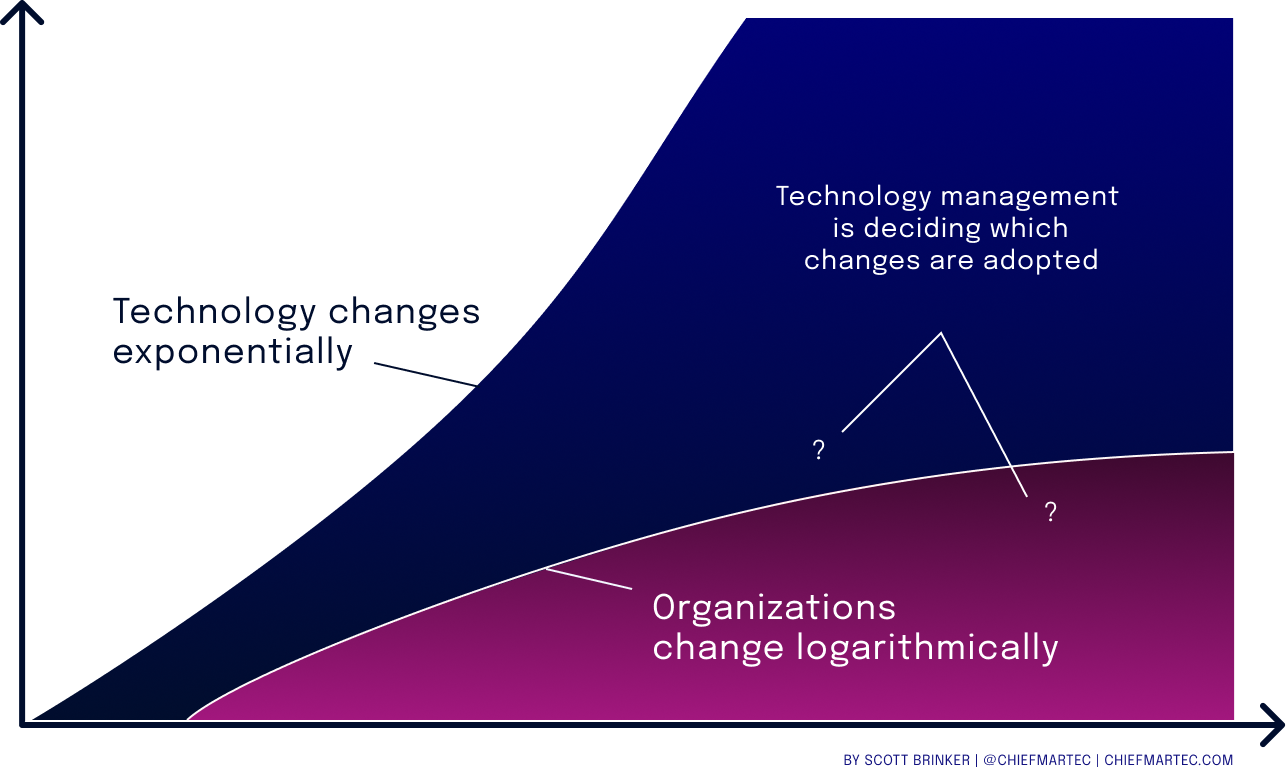
This model outlines a persistent gap organizations must manage, not a problem that can be permanently solved. In other words, it highlights the importance of choosing the right technologies for your organization — and accepting that adopting every available tool isn’t always possible or sustainable.
MarTech tools provide powerful solutions to modern organizations, and there’s no shortage of resources explaining how these systems work in practice. However, they tend to focus more on platform specifics and less around the need for a collaborative working model between Marketers and Technologists. In a previous article, we explored the idea of establishing a foundation that facilitates the impactful growth of content — or a platform built to facilitate Content Architecture at scale. This article extends that thinking by positioning Content Architecture as the core deliverable of MarTech systems.
Content architecture is a broad term covering how content is structured, presented, and evolves within and across systems. This term carries many interpretations and is commonly used alongside terms like Information Architecture to distinguish technical aspects like hierarchy, metadata, and taxonomies. In the context of MarTech, these disciplines consolidate under a single umbrella.
MarTech is exactly what it sounds like — the combination of Marketing and Technology. But Marketing didn’t suddenly discover Technology; it’s always been rooted in it. MarTech platforms exist to optimize the who, what, how, and when of an organization’s content lifecycle. This granular control is powered by collaboration between Marketing, Technology, and the ecosystem of applications that enable these integrations — the MarTech Stack.
Every organization has their own definition of success, and the capabilities that drive these platforms are shaped by the unique priorities of each. Because of this, MarTech Stacks rarely look the same from one organization to another. The same can be said about the terms marketing and technology, where the meaning is more relevant to the organization. For simplicity, we’ll remove the departmental connotations from MarTech and reframe each concern respectively as message (marketing) and function (technology). These two concerns work together, leveraging existing content and data to deliver the right information to the right folks at the right time.
Message is rooted in classic marketing concerns: content strategy, campaigns, audience segmentation, and more. Function is the technical side — managing the systems, workflows, APIs, and personalization engines that power the message’s capabilities and autonomy.
Viewing this two-sided model through the lens of Content Architecture as MarTech’s main deliverable, an additional concern emerges. Organizational variations in how marketing and technology roles are structured can make it difficult to build a solid foundation on message and function alone — one that provides end-to-end coverage of the content lifecycle. The table below maps different stages of the content lifecycle to message and function.
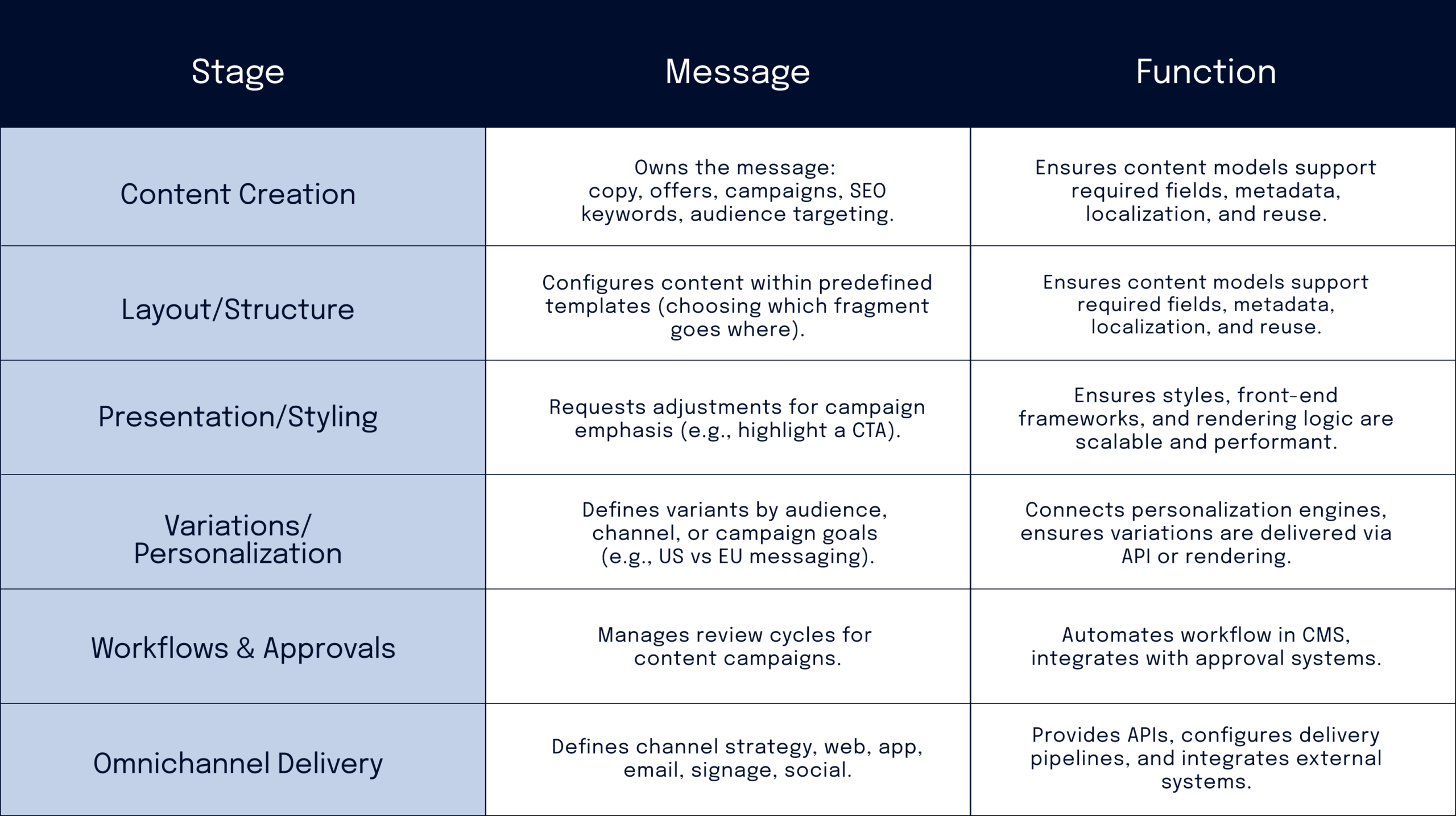
Let’s say the roles driving the function deliver a CMS that allows for complete flexibility and control for webpages. Assume this system was built around message and function and supports all the content activities in the table above. While this sounds like a home run, here’s why these two concerns might not be enough:
This isn’t to say that those executing the message can’t create on-brand content — but rather that too much platform flexibility can open the door for campaigns that don’t meet organizational standards. In theory, either role could have consulted a designer or UX strategist to manage those gaps, ensuring the system’s flexibility existed within the guardrails of the brand.
Returning to the general definitions of marketing and technology roles, each brings different strengths and capabilities. Just as marketers don’t commit code to production and technologists don’t write campaign copy, ownership of each concern should reside with the most appropriate role.
Marketers shouldn’t have to worry about sticking to brand guidelines because the systems should handle that for them. MarTech is designed to remove the human element from this equation, providing flexibility within constraints. To address this, we introduce a third concern: form, focused on design-centric aspects — like design systems, brand consistency, and accessibility — that are essential to informing both the message and function.
Form is not something that has been completely omitted from strategies or solutions relating to MarTech — quite the opposite. But it has been more of a ‘silent partner’ in the context of message and function. If Content Architecture is the main deliverable of these systems, then the message and function should also be explicitly addressing form as a contributor to provide a clear delineation of ownership across domains of expertise.
Adding in the concern of form to the content lifecycle table, we can more clearly see that while each role has a different relationship to an aspect of a concern, they must overlap to deliver the final solution.
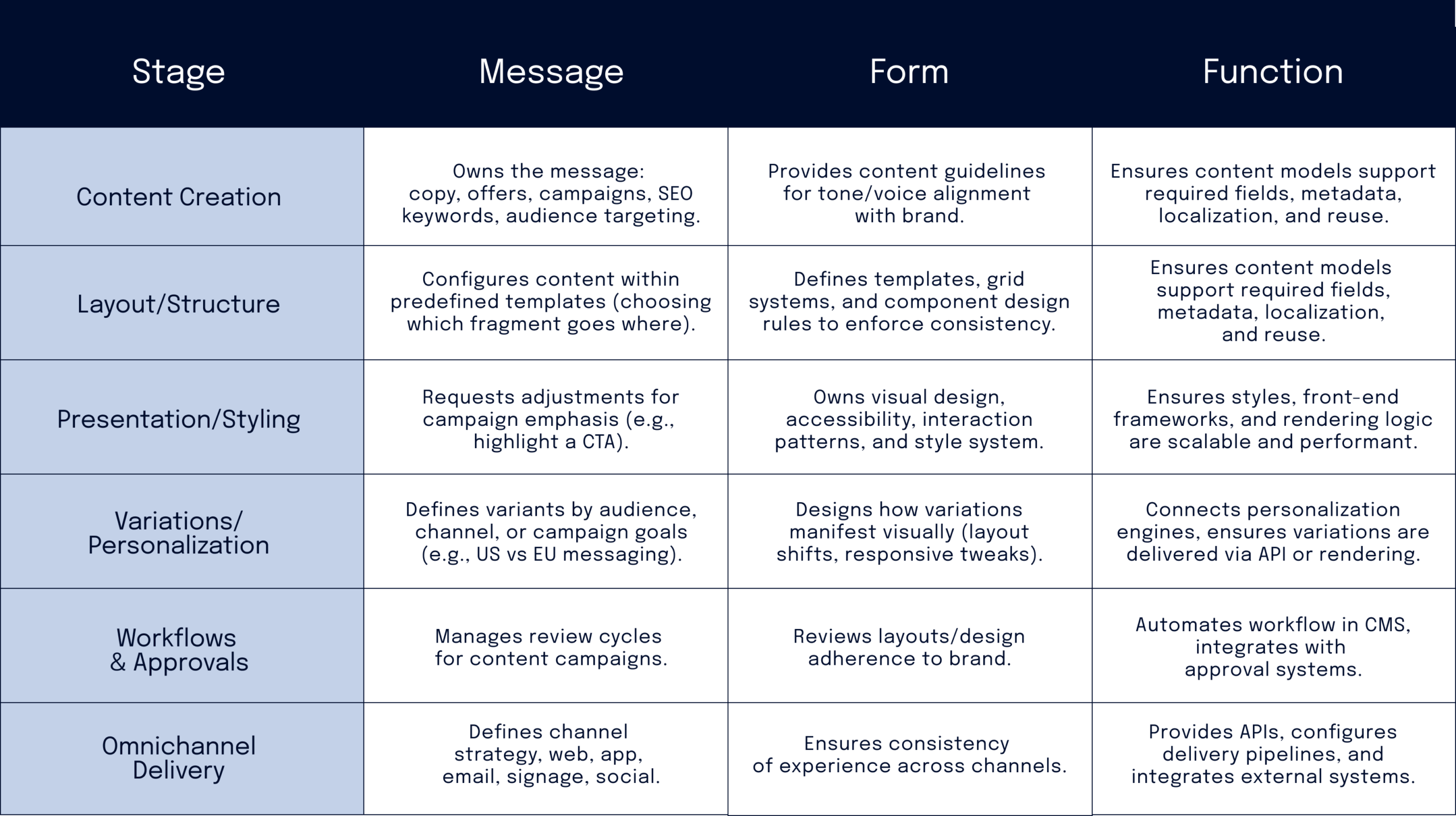
For these systems to scale effectively within your organization, each concern must share an equal balance. While the autonomy of the roles that drive each concern is essential, this is not a siloed endeavor but rather a collaboration between specialists that provide support towards each other’s objective of growing the organization’s revenue.
Imagine a wooden stool with three legs — message, form, and function. Each leg shares equal responsibility for supporting the seat: Content Architecture. Prioritize one at the expense of another, and you compromise the foundation, inviting instability. It doesn’t matter which leg is targeted; a single instance of misalignment sends things sideways.
Without form, Content Architecture often collapses into just structure. This results in a brittle model where your content may be correct from a technical standpoint, but is visually inconsistent, inaccessible, or unable to scale across multiple channels. Form elevates the architecture beyond the platforms where your content takes shape into the experience layer, where it can be confidently and intelligently delivered to its intended audience.
Content Architecture is more than just assets, taxonomies, or metadata models. It’s the connective tissue between the three concerns that determines not just what content exists, but how it can be reused, adapted, personalized, and governed across different channels and contexts. A well-designed Content Architecture supports roles within your organization to operate autonomously with content sitting at the fusion point of each concern. When Content Architecture is leveraged as the stabilizing layer, it ensures that all the aspects around the content lifecycle can scale and appropriately align with the goals of organizations.
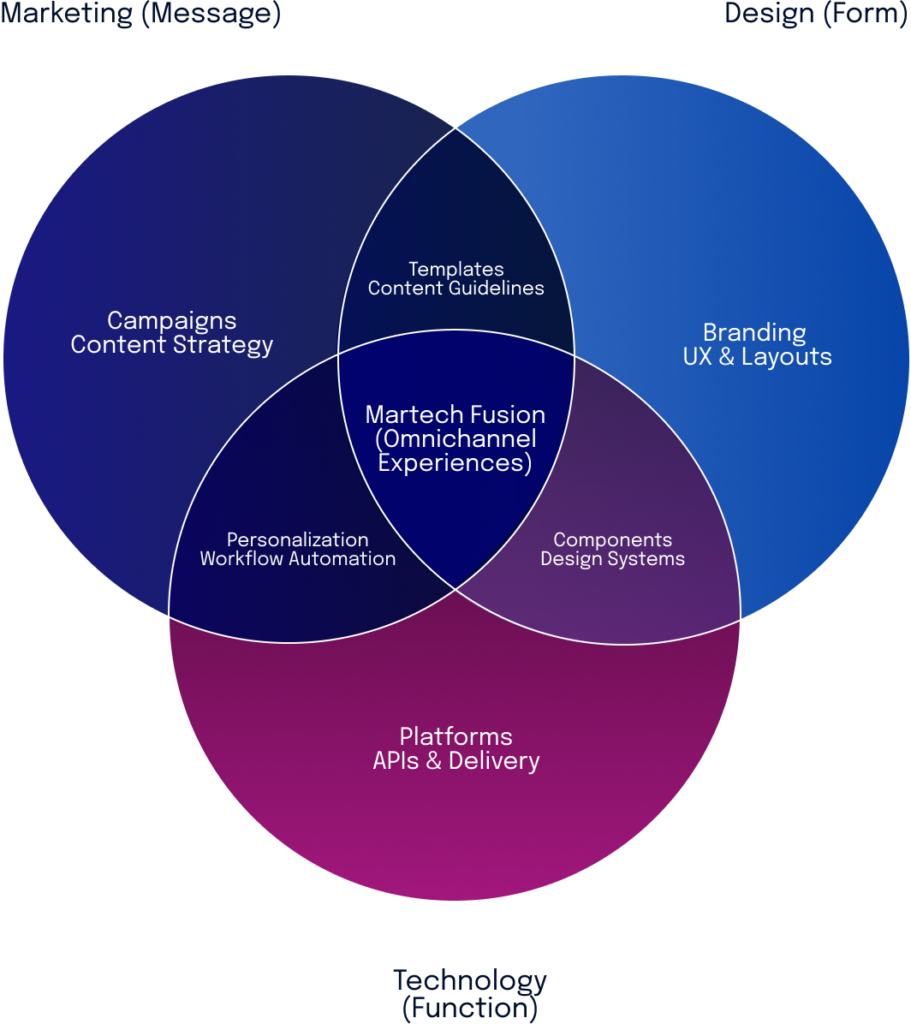
Let’s return to the question posed at the beginning: “What actually enables MarTech platforms to work at scale?” It’s the ability to facilitate open collaboration across an organization, with clearly defined concerns and shared responsibility rooted in the fusion of message, form, and function. A clear and consistent Content Architecture is the key to unlocking the value that MarTech platforms are designed to amplify.
If your MarTech tools feel more limiting than liberating, the right content architecture can change that. One North helps teams diagnose adoption challenges and design flexible structures that empower marketers while strengthening long-term internal capabilities.
Photo credit: Richardo Gomez Angel | Unsplash
Hunter is an Adobe Architect specializing in delivering implementations of Adobe products. Dedicated to continuous learning, he enjoys exploring new tools and methodologies while staying open to diverse perspectives. He has a strong passion for system design and architecture, focusing on creating effective and scalable solutions that meet current needs and adapt to future challenges.